【kick start】 2021 google kick start roundA
2021 google kick start roundA
kick start的题目果真质量非常高,非常值得学习和练习的题目,非常喜欢这类的题目,前三题都可以做出来,不过题目D确实很难,我感觉自己肯定想不到解答的答案的。前三题就是leetcode的难度,最后一题确实很难。
K-Goodness String (5pts, 7pts)
题目
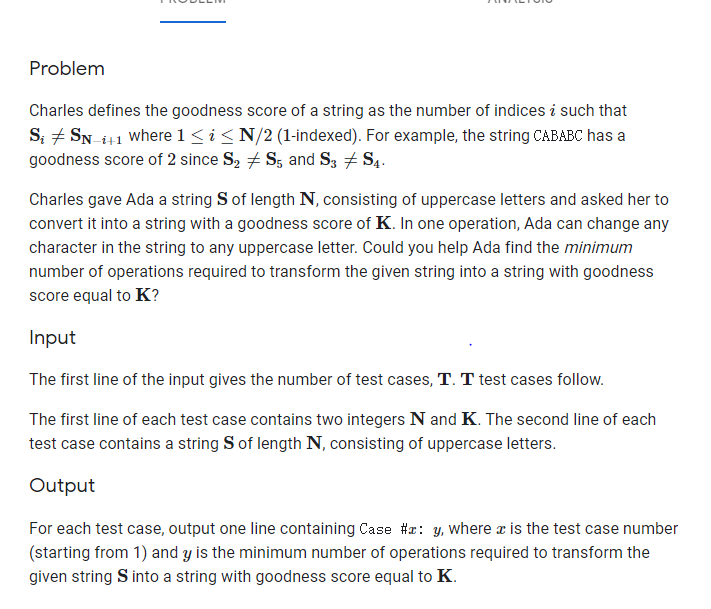
给定字符串,求出给定分值得最小变换次数
地址
https://codingcompetitions.withgoogle.com/kickstart/round/0000000000436140/000000000068cca3
题意
简单题目
思路
- 我们只需要求出$s[i] != s[n-1-i]$得字符对个数,最小的变换次数等于不同的字符对的个数与
k的绝对值之差。
2
3
4
5
6
7
8
9
10
11
12
13
14
15
16
17
18
19
20
21
22
23
24
25
26
27
28
29
30
31
32
33
34
35
36#include<iostream>
#include<vector>
#include<set>
#include<unordered_set>
#include<map>
#include<unordered_map>
#include<string>
#include<stack>
#include<algorithm>
#include<limits.h>
using namespace std;
void slove(int t){
int good = 0;
int bad = 0;
int ans = 0;
string str;
int n,k;
cin>>n>>k;
cin>>str;
for(int i = 0; i < (n>>1); ++i){
if(str[i] == str[n-1-i]) good++;
else bad++;
}
cout<<"Case #"<<t<<": "<<abs(k-bad)<<endl;
}
int main(){
int t;
cin>>t;
for(int i = 0; i < t; ++i){
slove(i+1);
}
return 0;
}
L Shaped Plots (8pts, 12pts)
题目
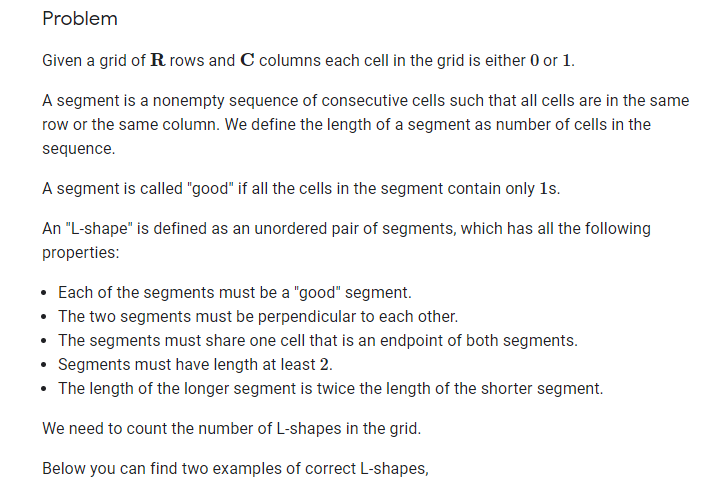
求出给定的矩阵中L的个数,L形要求:
L的两个线段必须分别在一行和一列,两个线段必须必须与行、列平行;L的两个线段有且只有一个点相交,且一条线段的长度为另一条线段的长度的两倍;L的两个线段的长度必须大于等于2;地址
https://codingcompetitions.withgoogle.com/kickstart/round/0000000000436140/000000000068c509题意
滑动窗口 + 前缀和
思路
- 我们分别求出以点
(x,y)为起点,分别往上下左右四个方向的最长的连续的1的长度。 - 分别求出以点
(x,y)为起点相交顶点的L的个数,分别在上下左右四个方向求一边,我们设L的两个线段的长度分别为$m,n$,则以m,n为长度的两个线段可能组成的L的形状个数为: - 时间复杂度$O(mn)$,空间复杂度$O(mn)$.
代码
1
2
3
4
5
6
7
8
9
10
11
12
13
14
15
16
17
18
19
20
21
22
23
24
25
26
27
28
29
30
31
32
33
34
35
36
37
38
39
40
41
42
43
44
45
46
47
48
49
50
51
52
53
54
55
56
57
58
59
60
61
62
63
64
65
66
67
68
69
70
71
72
73
74
75
76
77
78
79#include<iostream>
#include<vector>
#include<set>
#include<unordered_set>
#include<map>
#include<unordered_map>
#include<string>
#include<stack>
#include<algorithm>
#include<limits.h>
using namespace std;
void slove(int t){
int row;
int col;
int ans = 0;
cin>>row>>col;
vector<vector<int>> matrix(row,vector<int>(col));
vector<vector<int>> left(row,vector<int>(col));
vector<vector<int>> right(row,vector<int>(col));
vector<vector<int>> down(row,vector<int>(col));
vector<vector<int>> up(row,vector<int>(col));
for(int i = 0; i < row; ++i){
for(int j = 0; j < col; ++j){
cin>>matrix[i][j];
}
}
for(int i = 0; i < row; ++i){
int curr = 0;
for(int j = 0; j < col; ++j){
if(matrix[i][j] == 1) curr++;
else curr = 0;
left[i][j] = curr;
}
curr = 0;
for(int j = col-1; j >= 0; --j){
if(matrix[i][j] == 1) curr++;
else curr = 0;
right[i][j] = curr;
}
}
for(int j = 0; j < col; ++j){
int curr = 0;
for(int i = 0; i < row; ++i){
if(matrix[i][j] == 1) curr++;
else curr = 0;
up[i][j] = curr;
}
curr = 0;
for(int i = row-1; i >= 0; --i){
if(matrix[i][j] == 1) curr++;
else curr = 0;
down[i][j] = curr;
}
}
for(int i = 0; i < row; ++i){
for(int j = 0; j < col; ++j){
ans += max(min(left[i][j],up[i][j]/2) - 1,0);
ans += max(min(left[i][j]/2,up[i][j]) - 1,0);
ans += max(min(right[i][j],up[i][j]/2) - 1,0);
ans += max(min(right[i][j]/2,up[i][j]) - 1,0);
ans += max(min(left[i][j],down[i][j]/2) - 1,0);
ans += max(min(left[i][j]/2,down[i][j]) - 1,0);
ans += max(min(right[i][j],down[i][j]/2) - 1,0);
ans += max(min(right[i][j]/2,down[i][j]) - 1,0);
}
}
cout<<"Case #"<<t<<": "<<ans<<endl;
}
int main(){
int t;
cin>>t;
for(int i = 0; i < t; ++i){
slove(i+1);
}
return 0;
}
Rabbit House (9pts, 15pts)
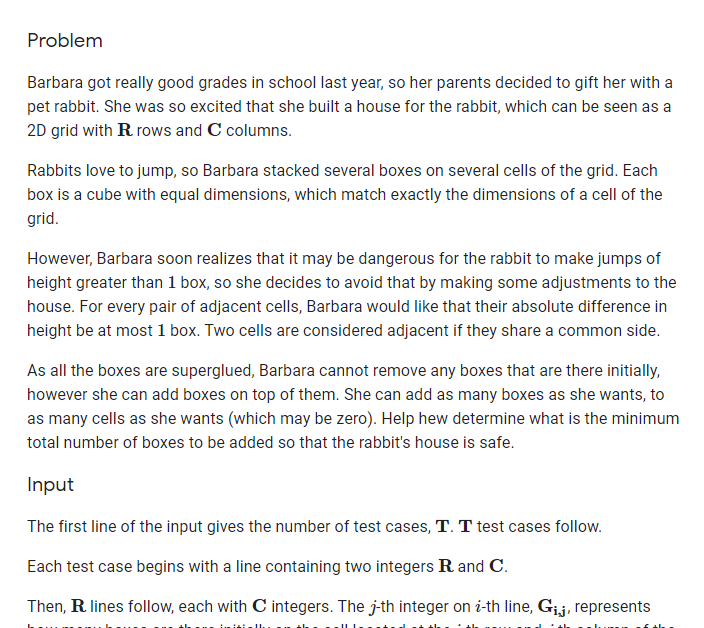
这个题目跟leetcode上的那个容器的题目很像,所以是中规中矩的题目,不算很难,靠自己还能思考出来。
地址
https://codingcompetitions.withgoogle.com/kickstart/round/0000000000436140/000000000068cb14
题意
优先级队列
思路
- 我们将矩阵中所有单元的高度按照从高到底依次排列,每次从队列中取除当前高度最高的单元$(x,y)$,高度为$h$,则此时必须满足$(x,y)$周围的四个格子$(x-1,y),(x+1,y),(x,y+1),(x,y-1)$必须要大于等于$h-1$,如果当前格子的高度发生改变则将其从新放入队列中。
- 非常简单的优先级对即可解决,时间复杂度为$O(mnlg(mn))$,空间复杂度为$O(m*n)$.
代码
2
3
4
5
6
7
8
9
10
11
12
13
14
15
16
17
18
19
20
21
22
23
24
25
26
27
28
29
30
31
32
33
34
35
36
37
38
39
40
41
42
43
44
45
46
47
48
49
50
51
52
53
54
55
56
57
58
59
60
61
62
63
64
65
66
67
68
69
70
71
72
73
74
75
76
77
78#include<iostream>
#include<vector>
#include<set>
#include<unordered_set>
#include<map>
#include<unordered_map>
#include<string>
#include<stack>
#include<algorithm>
#include<limits.h>
#include<queue>
using namespace std;
struct Node{
int x;
int y;
int val;
Node(int x,int y,int val){
this->x = x;
this->y = y;
this->val = val;
}
};
struct cmp{
bool operator()(Node & a,Node & b){
return a.val < b.val;
}
};
void slove(int t){
int row;
int col;
long long ans = 0;
int d[4][2] = {{0,1},{0,-1},{1,0},{-1,0}};
cin>>row>>col;
vector<vector<int>> matrix(row,vector<int>(col));
vector<vector<bool>> visit(row,vector<bool>(col,false));
priority_queue<Node,vector<Node>,cmp> pq;
for(int i = 0; i < row; ++i){
for(int j = 0; j < col; ++j){
cin>>matrix[i][j];
pq.push({i,j,matrix[i][j]});
}
}
while(!pq.empty()){
Node curr = pq.top();
pq.pop();
visit[curr.x][curr.y] = true;
if(curr.val != matrix[curr.x][curr.y]) continue;
for(int i = 0; i < 4; ++i){
int x = curr.x + d[i][0];
int y = curr.y + d[i][1];
if(x < 0 || y < 0 || x >= row || y >= col) continue;
if(visit[x][y]) continue;
if(matrix[x][y] < curr.val - 1){
ans += curr.val - 1 - matrix[x][y];
matrix[x][y] = curr.val - 1;
pq.push({x,y,matrix[x][y]});
}
visit[x][y] = true;
}
}
cout<<"Case #"<<t<<": "<<ans<<endl;
}
int main(){
int t;
cin>>t;
for(int i = 0; i < t; ++i){
slove(i+1);
}
return 0;
}
Checksum (10pts, 17pts, 17pts)
题目
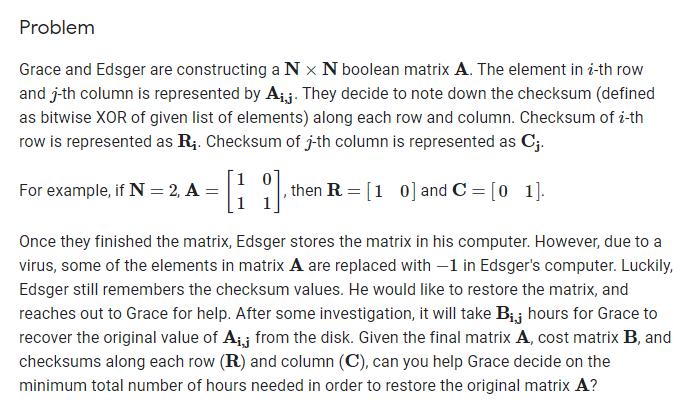
给定矩阵和每行每列的异或校验和,求恢复矩阵所需要的最小代价。
地址
https://codingcompetitions.withgoogle.com/kickstart/round/0000000000436140/000000000068c2c3
题意
最小生成树
解题思路
- 这个题目还是非常难的,根本不容易想到,我们首先将已经恢复的单元视作代价为$0$的未恢复的单元。
- 首先我们需要想到一个问题,思考一下我们至少需要恢复多少个单元,才能将所有的单元全部恢复,这个就是一个非常值得思考得问题,我们仔细想一下,因为已知每一行所有元素得异或校验和,则我们如果已经知道每一行的$n-1$个值,则我们就能通过校验和计算最后一个未知的数,对于每一列同样也是如此,所以我们可以猜测一下,我们至少需要恢复$(n-1)^{2}$个数据,才能完成所有的$n^{2}$数据恢复。
- 我们可以计算一下,如果恢复的元素超过$(n-1)^{2}$个,则我们可以计算出肯定存在某一行或者某一列恢复的数据为$n$个,这个对于我们来说是不必要的。
- 如果恢复的数据少于$(n-1)^{2}$,则此时我们还至少需要恢复$2*N$个数据,而我们实际上根据异或的校验和,至多能够推导出$2N-1$个数据。
- 根据以上推论,我们可以知道可以知道选择出最大的未解的$2n-1$个数据,剩余的$(n-1)^{2}$的数据恢复则花费的代价可能最小。如何选择$2n-1$个数据呢?假设我们按照以下顺序通过校验和来恢复最后剩余的$(2n-1)$个数据,顺序为:
$1 \rightarrow 2 \rightarrow 3 \rightarrow 4\rightarrow 5\rightarrow 6\rightarrow 7\rightarrow 8\rightarrow 9\rightarrow 10 \rightarrow 11$
2
3
4
5
60 0 0 9 0 8
0 2 0 0 3 0
0 0 5 0 4 0
0 1 0 0 0 0
0 0 6 0 0 7
11 0 0 10 0 0
我们实际可以知道将行与列分别看成生成树中的两个顶点,我们实际可以看出由行与列组成成的图不能有环,如果存在环的话,则一定存在某一行或者某一列中有两个未知数,则此时就不可能恢复该行或者该列的元素。- 根据以上得出我们只需要选出边与行的顶点组成的最大生成树,可以用
prim或者Kruskal算法即可。因为在此图中一个顶点连接的边很多,此时明显我们用prim算法的时间复杂度更好。- 代码直接
copy lucifer的。代码
2
3
4
5
6
7
8
9
10
11
12
13
14
15
16
17
18
19
20
21
22
23
24
25
26
27
28
29
30
31
32
33
34
35
36
37
38
39
40
41
42
43
44
45
46
47
48
49
50
51
52
53
54
55
56
57
58
59
60
61
62
63
64
65
66
67
68
69
70
71
72
73
74
75
76
77
78
79
80
81
82
83
84
85
86
87
88
89
90
91
92
93
94
95
96
97
98
99
100
101
102
103
104
105#include <algorithm>
#include <cstdio>
#include <iostream>
#include <vector>
using namespace std;
using ll = long long;
template <typename T> void read(T &x) {
x = 0;
char c = getchar();
T sig = 1;
for (; !isdigit(c); c = getchar())
if (c == '-')
sig = -1;
for (; isdigit(c); c = getchar())
x = (x << 3) + (x << 1) + c - '0';
x *= sig;
}
class UnionFind {
int n;
vector<int> parent, size;
public:
UnionFind(int n) {
this->n = n;
parent = vector<int>(n);
size = vector<int>(n, 1);
for (int i = 0; i < n; ++i)
parent[i] = i;
}
int find(int idx) {
if (parent[idx] == idx)
return idx;
return parent[idx] = find(parent[idx]);
}
void connect(int a, int b) {
int fa = find(a), fb = find(b);
if (fa != fb) {
if (size[fa] > size[fb]) {
parent[fb] = fa;
size[fa] += size[fb];
} else {
parent[fa] = fb;
size[fb] += size[fa];
}
}
}
};
class Solution {
public:
void solve(int case_num) {
printf("Case #%d: ", case_num);
int n;
read(n);
vector<vector<int>> a(n, vector<int>(n));
vector<vector<int>> b(n, vector<int>(n));
vector<int> r(n);
vector<int> c(n);
for (int i = 0; i < n; ++i)
for (int j = 0; j < n; ++j)
read(a[i][j]);
vector<tuple<int, int, int>> edges;
ll tot = 0;
for (int i = 0; i < n; ++i)
for (int j = 0; j < n; ++j) {
read(b[i][j]);
tot += b[i][j];
edges.emplace_back(b[i][j], i, n + j);
}
sort(edges.rbegin(), edges.rend());
UnionFind uf(n * 2);
for (int i = 0; i < n; ++i)
read(r[i]);
for (int i = 0; i < n; ++i)
read(c[i]);
ll remove = 0;
for (auto [weight, u, v] : edges) {
if (uf.find(u) == uf.find(v))
continue;
remove += weight;
uf.connect(u, v);
}
printf("%lld\n", tot - remove);
}
};
int main() {
ios::sync_with_stdio(false);
cin.tie(0);
int t;
read(t);
for (int i = 1; i <= t; ++i) {
Solution solution = Solution();
solution.solve(i);
}
}
#
欢迎关注和打赏,感谢支持!
- 关注我的博客: http://mikemeng.org/
- 关注我的知乎:https://www.zhihu.com/people/da-hua-niu
- 关注我的微信公众号: 公务程序猿

【kick start】 2021 google kick start roundA
http://example.com/2026/09/08/力扣周赛题解/72/